How to Calculate Pro Rata in Excel
An employee starts on the 11th of the month - how much of their monthly salary do they earn? A fund distributes dividends - how much goes to each investor based on the number of shares they hold? A tenant moves out on the 18th - what fraction of the rent covers the days they actually occupied the unit?
All of these are pro rata calculations: dividing a total amount into proportional pieces based on some measurable unit (time, shares, headcount, square footage, etc.). The Latin phrase means “in proportion,” and the math always comes back to the same core formula. Excel makes it trivial - one cell for a simple split, a short column for a multi-party allocation.
This guide covers the universal pro rata formula, three common real-world scenarios (time-based, share-based, and multi-party), and the rounding problem that trips people up when the pieces must sum exactly to the total.
The Pro Rata Formula
Every pro rata calculation is a single expression:
Where:
- Amount is the total value being divided (a salary, a budget, a dividend pool, a rent payment).
- Total is the full measure of the allocation base (total days in the month, total shares outstanding, total headcount, etc.).
- Portion is the slice of the base that belongs to the party you are computing for (days worked, shares held, headcount in a department, etc.).
The ratio Portion / Total is the party’s pro rata share, a number between 0 and 1. Multiply by the amount, and you have their allocation. That is the entire concept.
Scenario 1: Time-Based Proration
This is the most common case: an amount that covers a full period (a month’s salary, a month’s rent, an annual insurance premium) needs to be split because someone started or stopped partway through.
Example
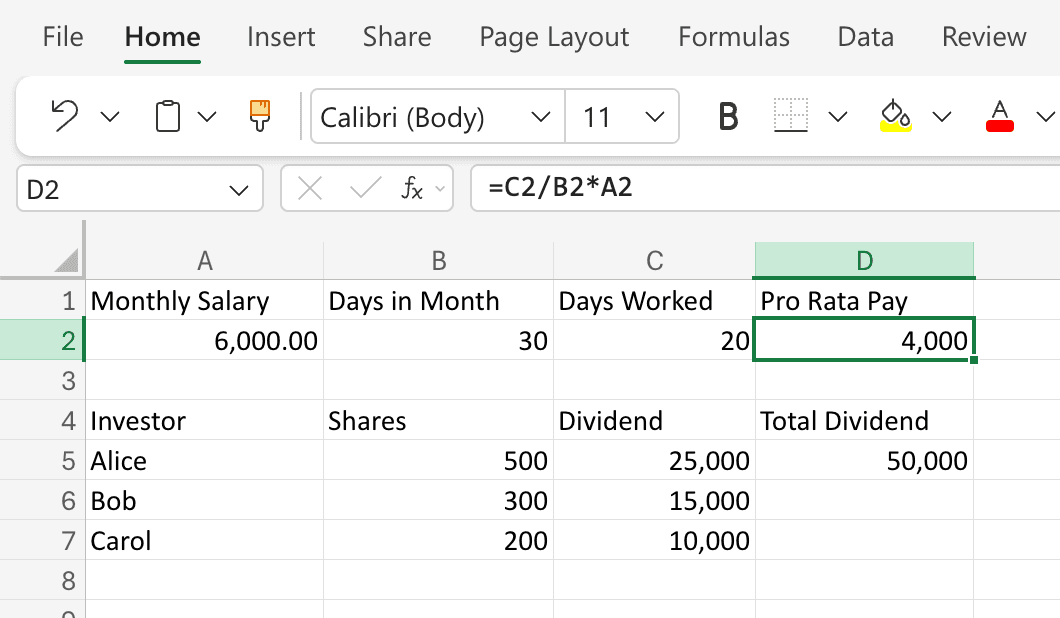
An employee’s monthly salary is $6,000. They start on the 11th in a 30-day month. What do they earn for that first month?
| Cell | Contents |
|---|---|
A1 | Monthly Salary |
A2 | 6000 |
B1 | Days in Month |
B2 | 30 |
C1 | Days Worked |
C2 | 20 |
D1 | Pro Rata Pay |
D2 | (formula here) |
In D2:
=C2/B2*A2
Excel returns $4,000.00 - 20 out of 30 days at $6,000.
Counting the days automatically
If you have the start and end dates rather than a day count, let Excel do the arithmetic:
- In
B2, enter=EOMONTH(start_date, 0) - EOMONTH(start_date, -1)to get the number of days in the month. - In
C2, enter=EOMONTH(start_date, 0) - start_date + 1to get the days from the start date through month-end (inclusive).
Here, start_date means the cell or named range that contains the actual start date you enter in Excel.
This removes manual counting errors and automatically adjusts for months of different lengths.
Scenario 2: Share-Based Distribution
A company or fund distributes a fixed pool of money to holders in proportion to the number of shares (or units, or percentage interests) each holds.
Example
A fund distributes $50,000 in dividends. Three investors hold shares:
| Cell | Investor | Shares |
|---|---|---|
A2 | Alice | 500 |
A3 | Bob | 300 |
A4 | Carol | 200 |
Total shares: 1,000. Dividend pool: $50,000 (put this in D1 or a named cell).
In C2, compute Alice’s allocation:
=B2/SUM($B$2:$B$4)*$D$1
Copy down to C3 and C4. Results:
- Alice: $25,000 (50%)
- Bob: $15,000 (30%)
- Carol: $10,000 (20%)
The dollar signs ($) anchor the total-shares range and the dividend pool so the formula copies correctly.
Scenario 3: Multi-Party Budget Allocation
A $120,000 annual marketing budget is split across four departments by headcount:
| Department | Headcount | Allocation |
|---|---|---|
| Sales | 40 | $48,000 |
| Engineering | 30 | $36,000 |
| Marketing | 20 | $24,000 |
| Support | 10 | $12,000 |
| Total | 100 | $120,000 |
The formula in each allocation cell is identical to Scenario 2: =Headcount / Total Headcount * Budget. The allocation base changed from shares to headcount, but the structure is the same - that is the point of pro rata.
The Rounding Problem
Pro rata calculations frequently produce results with many decimal places. If you round each party’s share individually, the rounded values may not sum to the original total.
Example: $100 split equally among three parties gives $33.333… each. Rounding each to $33.33 gives a total of $99.99 - a penny short.
The “largest remainder” fix
One common reconciliation method:
- Compute each party’s exact (unrounded) allocation.
- Round each allocation down (for cents, use
ROUNDDOWN(value, 2)). - Compute the leftover:
Total - SUM(rounded allocations). - Distribute the leftover one unit at a time (one cent, one dollar, whatever the rounding unit is) to the parties with the largest fractional remainders.
In the three-way split of $100:
- All three get $33.33 after rounding down.
- Leftover is $0.01.
- Give the penny to whichever party you designate as the “remainder recipient” (often the largest shareholder, or the first in the list by convention).
For most business purposes, simply rounding each cell with =ROUND(..., 2) and adjusting the last party’s amount to =Total - SUM(all other rounded amounts) is the pragmatic approach. This guarantees the column sums exactly to the total without building a full largest-remainder algorithm.
A Note on Day-Count Conventions
For time-based proration, the number you put in the “Total” slot matters more than people expect:
- Actual days in the month (28, 29, 30, or 31): the most common approach for payroll and rent.
- Standardized 30-day month (30/360 convention): used in some bond markets and insurance. Every month is treated as 30 days regardless of calendar length.
- Actual/365 or Actual/360: used in money markets and loan interest calculations.
The formula is the same in all cases - only the denominator changes. Make sure you know which convention your contract or policy requires before plugging in numbers.
Common Mistakes
- Using the wrong total. A 31-day month with 30 in the denominator (or vice versa) shifts every result. Double-check the period length.
- Mixing units. The numerator and denominator must be in the same unit. Days worked vs. total hours in the month is meaningless.
- Rounding each row and expecting the sum to match. It won’t, except by coincidence. Always reconcile to the total, either by adjusting the last row or using the largest-remainder method.
- Forgetting to anchor references. In a multi-party split, the total and the pool should use absolute references (
$B$10,$D$1) so the formula copies cleanly down the column. - Double-counting boundary days. Does the employee’s start day count as a worked day? Does the tenant’s move-out day count? The answer depends on the contract. Off-by-one errors are the most common source of pro rata disputes.
Frequently Asked Questions
What does “pro rata” actually mean?
It is Latin for “in proportion.” In practice it means dividing something (money, time, resources) into shares that are proportional to some measurable base (days, shares, headcount, square footage, etc.).
Is there a built-in Excel function for pro rata?
No. Excel has no dedicated pro rata function, but the calculation is a simple arithmetic expression: =Portion/Total*Amount. For time-based proration with dates, functions such as EOMONTH, DAYS, or DATEDIF can help you build the numerator and denominator.
How do I handle pro rata for leap years?
If you use actual days, February has 29 days in a leap year and the denominator adjusts automatically. If you use a 30/360 convention, February is treated as 30 days regardless. Know which convention applies before calculating.
Can I pro rate across unequal periods?
Yes - that is the whole point. The formula works regardless of whether the periods are equal. A 28-day February and a 31-day March each use their own day count in the denominator. As long as the numerator and denominator use the same unit, the ratio is correct.
How do accountants handle the rounding leftover?
The most common practice is to assign the residual (the difference between the total and the sum of the rounded allocations) to the largest party, the last party in the list, or a designated “plug” line. In formal financial reporting, the largest-remainder method is sometimes used to distribute the residual across multiple parties. The key rule is that the rounded allocations must sum exactly to the original total.